Air Quality Monitors vs. Professional Testing: What Your Home Monitor Can’t Tell You
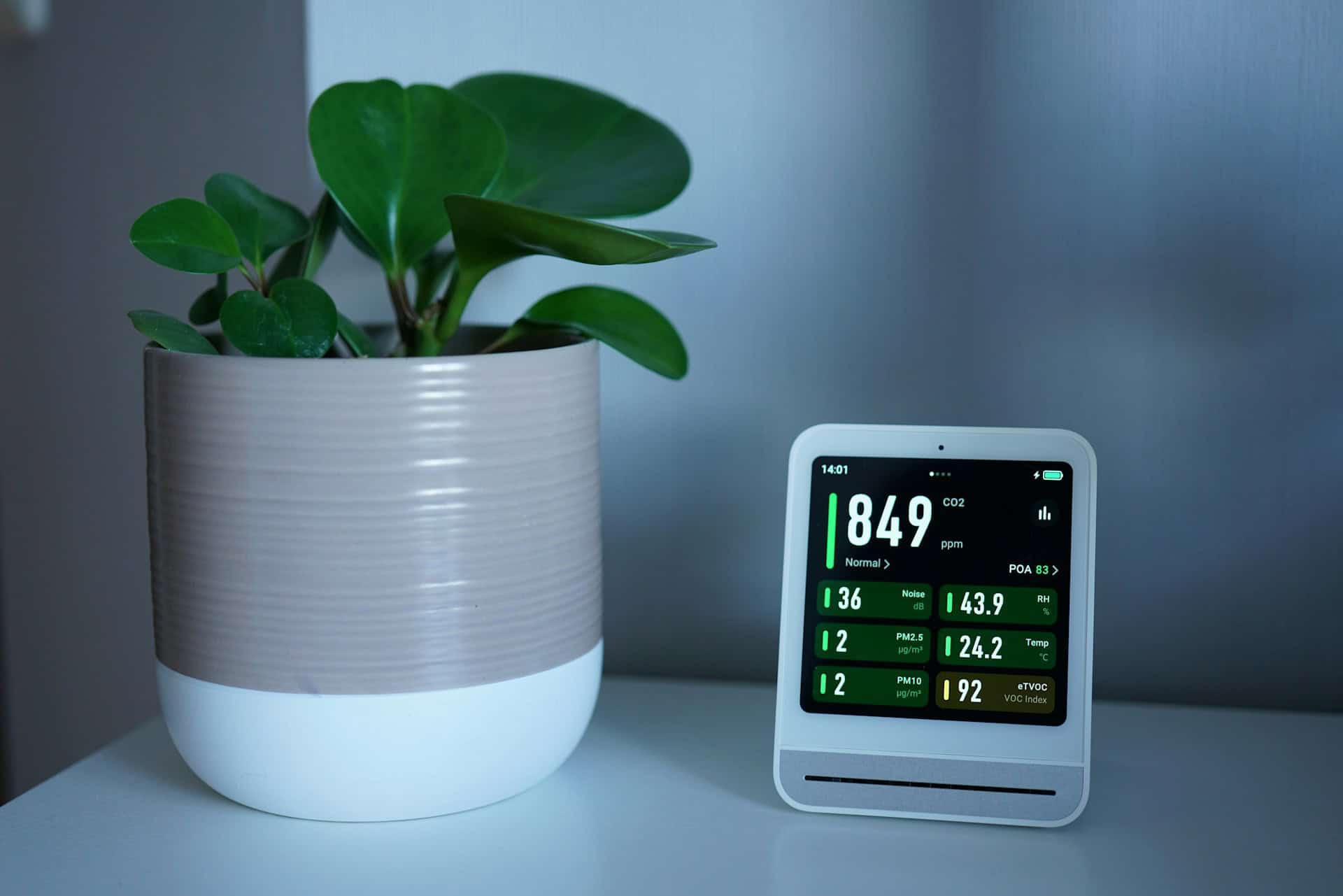
A home air quality monitor counts particles and tracks conditions like humidity, carbon dioxide, and temperature. It cannot tell y...


A home air quality monitor counts particles and tracks conditions like humidity, carbon dioxide, and temperature. It cannot tell you what those particles are. Professional indoor air quality testing answers a different question: what is actually in the air, and where.
Your phone buzzed. The air quality monitor app says mold risk is high, or the VOC number jumped, or the ring on the device turned orange. You opened a window like the app suggested, and a few hours later the number came back down.
The reading improved, which is worth noting because a number going down tells you the air near that one sensor changed. However, it does not tell you whether the thing that caused the spike is gone.
Indoor air quality monitors are useful, and this is not an argument against owning one. But they were built to show patterns over time, not to name what is in your air.
No. A home air quality monitor cannot specifically detect mold spores or tell you what kind of mold is present.
Most consumer monitors use an optical particle sensor, which shines a laser through a small air sample and measures how floating particles scatter that light. From the scatter pattern, the device works out how many particles are present and roughly what size they are.
Size and count are the whole output. The sensor has no way to determine what a particle is made of, which is why a monitor can report a spike without being able to say what spiked.
Mold spores do scatter light. So does drywall dust, cooking smoke, pollen, pet dander, and the grit off a treadmill belt. The sensor counts all of it and reports one number. It cannot separate types of mold from each other, or from anything else in the room.
Several monitors on the market display a mold risk score. None of them are detecting mold.
These features run a calculation, not a measurement. The inputs are temperature, humidity, and time, usually looking back over the previous day or two. When a room stays warm and damp long enough, the score climbs, because those are the conditions mold needs to grow.
That calculation can be useful. Damp, warm conditions sustained over two days are worth knowing about, because that is how mold growth starts.
What the score cannot do is look behind your shower wall. Mold growing inside a wall cavity gives off no signal a room sensor can read, so a monitor will not flag moisture trapped in construction from a roof leak or a slow plumbing failure. And it says nothing about rooms where the device is not sitting.
A TVOC reading is a single combined number. It cannot separate a scented candle from formaldehyde off-gassing from new flooring.
VOC stands for volatile organic compound: chemicals that evaporate into the air at room temperature, and among the most common indoor air pollutants. Paint, adhesives, cleaning products, furniture, and cooking all release them. So do some compounds mold produces while it grows.
Consumer sensors report all of it as one total. The sensor type used in home devices responds to a broad range of compounds at once and returns a combined index, with no mechanism for telling one compound from another. Naming individual compounds takes laboratory instrumentation, typically gas chromatography paired with mass spectrometry.
This is why the nighttime VOC spike is such a common question among device owners, and such a frustrating one. The number says something changed in the room, but finding out what changed takes a different tool.
Some contaminants are invisible to consumer devices, not because the sensors are weak, but because they measure the wrong thing.
| What you may be worried about | What a home monitor reports | What it takes to get an answer |
|---|---|---|
| Whether particles are biological | Total particle count, undifferentiated | Instrument with fluorescence detection |
| Mold species | Total particle count | Spore trap cassette analyzed at an accredited lab |
| Asbestos fibers | Total particle count | Sample collected and analyzed under a microscope |
| Lead dust | Nothing | Surface wipe sample, lab analyzed |
| Meth residue | Nothing | Surface wipe sample, lab analyzed |
| Radon | pCi/L reading on some models | 48-hour minimum test with a professional device |
| Carbon monoxide | Reading on some models | A listed CO alarm, which is a safety device, not a monitor feature |
Asbestos illustrates the gap. The CDC’s toxicological profile notes that even phase contrast microscopy, a standard lab method, cannot distinguish asbestos fibers from other fibers. Confirming asbestos takes electron microscopy, which examines a fiber’s shape, crystal structure, and elemental makeup. A device counting light scatter has no path there.
Lead dust and meth residue sit outside a monitor’s reach for a different reason: both are measured as surface contamination, not as something airborne. Colorado caps meth at 0.5 micrograms per 100 square centimeters of surface. No air reading produces that number.
Use a monitor to watch trends and conditions, not to reach conclusions about contaminants.
This is where these devices can earn their place. They show whether bathroom humidity stays high long after a shower, whether carbon dioxide climbs in a closed bedroom overnight, whether particle counts spike when the furnace kicks on.
Those patterns point to real contributors to poor indoor air quality: weak ventilation, lingering moisture, HVAC systems needing attention. A monitor that reveals your bathroom fan is not moving enough air has done something worthwhile, because keeping humidity down is one of the more reliable ways to prevent mold growth.
A few things worth knowing when you read the numbers:
Professional indoor air quality testing uses instruments built to answer the question a consumer sensor skips: whether an airborne particle is biological or not.
Integrity’s real-time digital optics equipment flashes ultraviolet light at the particle, and biological particles fluoresce, because compounds inside them such as NADH and riboflavin glow at predictable wavelengths when excited.
A consumer monitor reports that particle counts rose. An instrument with fluorescence detection reports that what rose is biological, and shows how each room compares to every other room and to the outdoor air that same day. Also, biology differs. Mold, bacteria/viruses, and pollens are all different.
Because there is no per-sample lab fee attached to real-time scanning, every room gets tested rather than the two or three a homeowner could justify paying a lab to analyze. That coverage matters: research using repeated air samples in one room across a single day has found variability of as much as 10,000-fold, because spores release in bursts rather than steadily. One sample in one room tells you about that room, in those five minutes.
While it differentiates between types, it does not name the species. The instrument sorts biological particles (mold, bacteria/viruses, pollens) from non-biological ones, then reports on whether the mold types and quantities are normal vs abnormal.
That limitation matters less than it sounds, for reasons we covered in our breakdown of how testing equipment affects your results. If you have abnormal airborne mold readings, cleanup follows the same steps regardless of what specific types are making it ‘abnormal’. Where naming the species is required due to a specific allergy, a spore trap cassette sent to an accredited lab is the right tool, and the two methods get run together rather than chosen between.
Certain situations call for more than a device on a shelf.
If someone in your home has symptoms that improve when they leave and return when they come back, start with their doctor. A physician can evaluate symptoms; an environmental test cannot. The medical conversation comes first.
Beyond that, professional air quality testing services make sense when:
Colorado adds two triggers of its own. State law gives buyers the right to test for prior methamphetamine lab use, and every residential contract must carry a radon disclosure recommending a test before purchase. A home radon monitor reading is useful, but not approved documentation for a transaction.
Your home air quality monitor is a smoke alarm, not a fire investigator.
It can tell you something(s) in the room has changed, which is worth knowing and worth acting on when humidity stays high or carbon dioxide climbs overnight. It’s what it cannot do that should concern you. You simply cannot compare a $40K instrument and it’s capabilities with a $129 monitor.
Integrity Environmental Testing performs testing only, with no remediation work, so the people reading your results have no stake in what those results say. That independence is worth asking about with any company you consider, including us.
If your monitor has been telling you something you cannot explain, Request Your Free Consultation Today.
Is there a home air quality monitor that detects mold?
No consumer monitor detects mold spores directly. Devices marketed for mold either measure humidity and temperature to estimate growth conditions, or count airborne particles without determining what they are, including the species people mean by black mold.
Why do two monitors in the same room show different numbers?
Sensor variation, measurement intervals, and small differences in airflow around each device all contribute. Manufacturers publish help articles about it. Watch patterns over days rather than reacting to a single reading.
Do I need to know what type of mold it is?
Usually not, since cleanup follows the same steps regardless of mold type. It becomes worth determining when a doctor has tied someone’s illness to a specific organism, or when an insurance claim needs the documentation.
What is a safe level of mold in indoor air?
No federal standard exists. The EPA and CDC both confirm there are no established limits for airborne mold, which is why qualified assessments compare indoor readings against a same-day outdoor control, and types and quantities which are historically found under normal conditions, rather than a fixed number.